MEAN Stack Development Explained: Angular, Node.js & MongoDB Career Guide
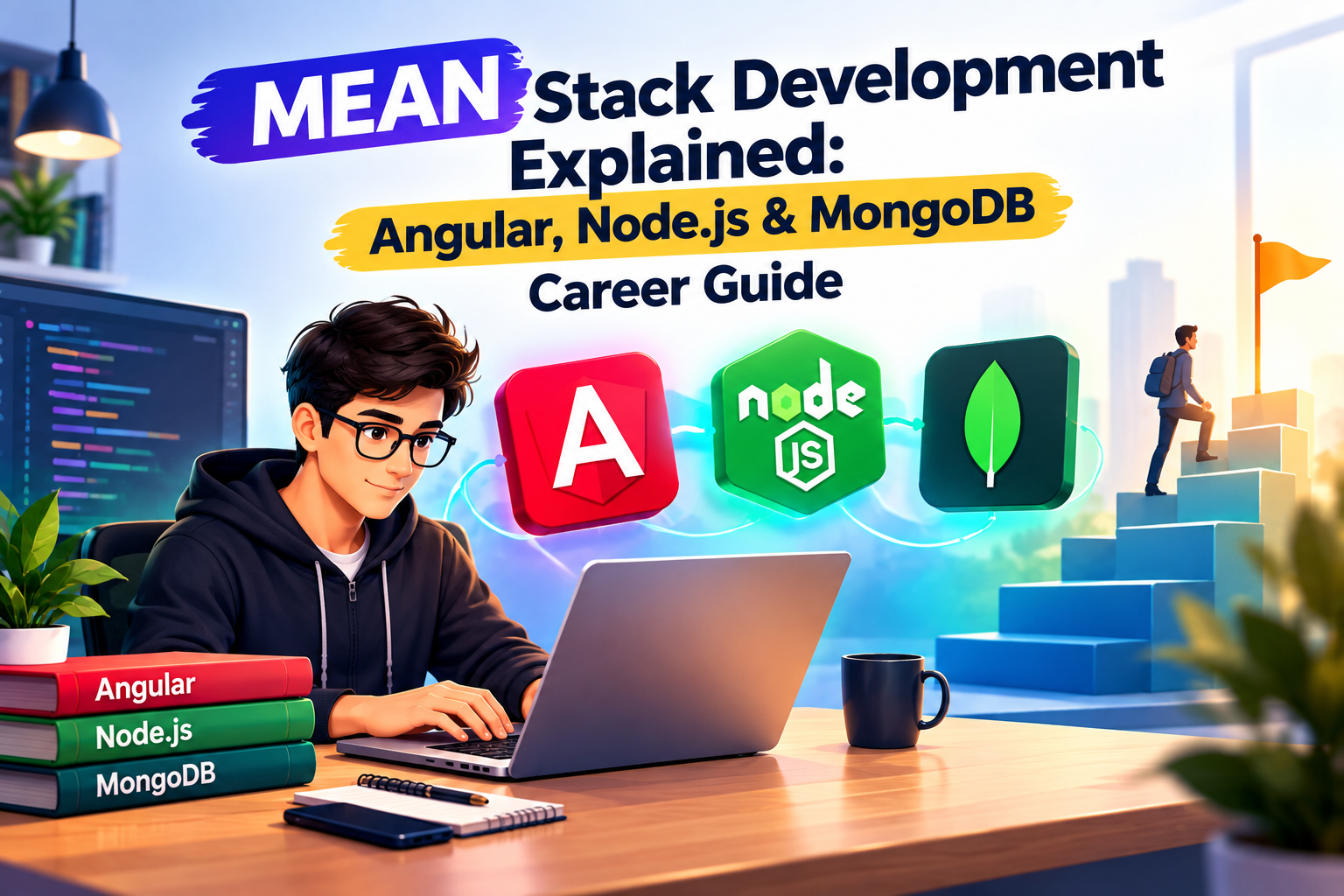
Every few months a new stack gets crowned as the future, and every few months a fresh batch of learners panics about picking the wrong one. MEAN has survived that cycle better than most. It has been called old, called boring, and called dead by people who then quietly used it at work. If you are wondering whether it still deserves a place in your learning plan, this guide walks through what the stack really is, how the parts fit together, and how you can turn it into a career without burning out on the way.
I will keep this conversational and practical. No wall of buzzwords, no promises of overnight jobs, just the kind of explanation you would want from a senior friend sitting next to you with a cup of chai.
Why MEAN Feels Like a Good First Full Stack Home
The Comfort of a Single Language
Most beginners hit a wall when they realise that building one working website seems to require learning three unrelated languages. MEAN removes a big part of that pain. MongoDB stores data in a format that looks like JavaScript objects, Express and Node.js run your server logic in JavaScript, and Angular builds the screen using TypeScript, which is JavaScript with better manners. Your brain keeps using the same grammar from the database all the way to the browser, and that continuity makes progress feel less like climbing separate mountains.
A Stack With Opinions
Angular is famous for being opinionated, and that is a compliment once you work on a team. It tells you where files go, how components talk, how forms are validated and how services share data. New developers sometimes resent this, then grow to love it when a project reaches fifty screens and everything is still findable. That predictability is one reason banks, insurers, logistics firms and large enterprise teams still hire Angular developers in big numbers.
Unpacking the Four Letters Without the Jargon
M for MongoDB
MongoDB is a document database, which means each record is a self contained bundle rather than a row squeezed into a rigid grid. Imagine a travel app where every trip has a different number of stops, notes and photos. A strict table would force awkward workarounds, while a document simply holds whatever that particular trip needs. You still design your data thoughtfully, but you get room to evolve it as your idea matures, and that freedom is a gift while you are experimenting with early versions of a product.
E for Express
Express.js is the small framework that turns Node.js into a friendly web server. It lets you define routes such as one for fetching all bookings and another for creating a new one, then attach little pieces of logic called middleware that run along the way. Authentication checks, request logging and input cleaning all live comfortably in this layer. Learning Express feels like learning to arrange furniture in a room you already understand, because the concepts are few and the payoff is immediate.
A for Angular
Angular is where the human being meets your application. It gives you components that combine structure, style and behaviour, services that hold shared logic, and a router that moves people between pages without reloading everything. Its handling of forms is particularly strong, which matters more than people admit, since a huge share of business software is really just clever forms. The learning curve is real, but every hour spent understanding its ideas returns value in other frameworks too.
N for Node.js
Node.js is the engine room. It runs JavaScript on the server, talks to the file system and the database, and handles thousands of small requests without getting flustered. Its event driven nature means it does not sit idle waiting for one slow task to finish, so it can serve many users at once. Behind the scenes, Node also brings a giant ecosystem of packages, meaning that many problems you meet have already been solved by someone kind enough to share their work.
Following One Click From Start to Finish
Suppose someone opens a ticket booking site and taps a button to see available seats for Saturday. Angular reacts first, sending a request to your server address. Node receives it and hands it to Express, which recognises the route and runs the matching function. That function asks MongoDB for the seat documents connected to Saturday, gets them back in a flash, and Express sends them to the browser as JSON. Angular takes that data, updates the component, and the person sees a colourful seat map appear. The whole round trip usually takes less time than a blink.
Once this loop clicks in your head, debugging becomes so much easier. If the seats do not appear, you can ask a sensible question at each stage. Did the button trigger the request, did the server receive it, did the query return anything, did the response reach the browser and did the component display it correctly? Beginners often lose a whole evening because they never break the problem into these stages, and when you look at how many people lose that evening in almost the same way, you realise it is a learning habit and not a talent problem. The fix is nothing more mysterious than reading each layer patiently.
A Roadmap That Feels Human
Weeks One and Two: Make Friends With JavaScript
Do not rush into frameworks. Spend real time on functions, arrays, objects, scope, promises and async behaviour, because these ideas surface in every corner of the stack. Add basic HTML and CSS so that whatever you build does not look like a homework sheet. Write small programs daily, even silly ones, such as a tip calculator or a quote generator, because muscle memory matters more than memorised syntax.
Weeks Three to Five: Build a Backend You Are Proud Of
Now set up a Node project and create a small API with Express connected to MongoDB. Add routes to create, list, update and delete records. Then introduce user registration and login, learn how tokens keep sessions alive, and practise validating incoming data so that strange input does not crash your server. This is also the perfect stage to learn testing endpoints with a client tool, so that you can prove your backend works before any screen exists.
Weeks Six to Nine: Step Into Angular
With a working API waiting, Angular becomes far less scary because you already know what data it will consume. Learn components, templates, directives, services, routing and reactive forms. Practise fetching data, showing loading and error states, and keeping the interface tidy as it grows. Pay attention to how you organise folders, since good structure will save you from confusion later.
Weeks Ten to Twelve: Ship Something Real
Combine everything into a complete project, and this time treat it like a product. Choose an idea that solves a small genuine problem, perhaps a hostel mess menu tracker, a local tutor booking board or a tool that helps a friend manage their small business orders. Deploy it online, write a clear description, and record a short walkthrough. A working link and a thoughtful explanation impress recruiters more than a long list of technologies.
What Employers Quietly Look For
Projects That Show Judgement
Hiring managers rarely expect perfection from a fresher, but they do notice judgement. Did you validate user input, handle errors gracefully, and keep secrets out of your code? Did you think about what happens when the database is slow or a user does something odd? Talking about these decisions in an interview shows maturity that no certificate can fake.
Communication and Curiosity
Teams want people who can explain a bug in plain language, ask for help without shame, and accept feedback without taking it personally. Curiosity beats memory here. Someone who can say, "I am not sure, but here is how I would find out," often wins over someone who recites definitions and freezes when the question changes shape.
Interview Topics Worth Revisiting
Expect questions about how the event loop works, what middleware does, how Angular handles change detection, when to choose a document database over a relational one, and how you would secure an API. You may also be asked to build a small feature live or walk through a project from your portfolio. Practise explaining your own work aloud, because speaking clearly about something you built is a skill that improves only with repetition.
Career Paths That Open Up
Roles to Aim For
A solid MEAN foundation prepares you for junior full stack developer roles, Angular frontend positions, Node.js backend jobs and web application development in service or product companies. Freelancing is also a realistic path, since small businesses constantly need dashboards, booking systems and internal tools that this stack handles comfortably.
Growing After the First Offer
After a year or two, developers usually pick a direction. Some go deeper into backend design, learning caching, queues, security and scaling. Others move toward frontend architecture, accessibility and performance. Some become comfortable with cloud deployment and automation, which makes them valuable in small teams that cannot afford separate specialists. Your JavaScript base also makes lateral moves easier, including toward other frontend frameworks or serverless approaches.
Myths That Deserve Retirement
People say MEAN is outdated, but plenty of large applications still run on it and need maintenance, upgrades and new features every single month. People also claim you must master everything before applying, which is untrue, since most teams hire for potential and fundamentals. Another popular myth is that full stack means being an expert at every layer. In reality it means being useful across the layers, comfortable enough to move a feature from idea to release, and honest about where you need to grow.
Your Next Small Move
Do not wait for the perfect week to start. Tonight, create an empty folder, initialise a Node project, and make a server that replies with a friendly message. Tomorrow, connect it to a database. By the weekend you could have a tiny API, and by next month a small application with a real face. If you would rather have a steady rhythm than teach yourself in scattered bursts, spending time around people who have already shipped serious web projects can make the whole climb feel lighter and a lot faster. Whatever route you pick, keep building in public, keep your curiosity loud, and let your work introduce you to the industry.