MEAN Stack Developer Interview Questions and Preparation Guide
Five interview rounds, five kinds of nerves, and the MongoDB, Express, Angular and Node.js ideas that quietly decide each one
Here is something nobody tells you before your first developer interview: you will not face one test. You will face a series of small, different conversations, and each one is looking for a slightly different quality in you. Preparing for a mean stack developer role as though it were a single exam is why so many people feel oddly unready despite studying for weeks.
So this guide is organised by round. We will walk through what each one usually feels like, the questions that tend to appear, a few facts about MongoDB, Express, Angular and Node.js that make your answers sound current, and a way to practise that fits around a real life. Grab a notebook, because the best way to use this is to pause after each question and answer it aloud before you read on.
Five Rounds, Five Different Kinds of Nervous
Before the rounds themselves, it helps to settle one question that sits underneath all of them. Interviewers use it as a warm up, and your answer sets the tone for everything that follows.
The Definition of a Full Stack Developer as Round One Sees It
The definition of a full stack developer is simpler than the internet suggests. It describes someone who can work on the front end, the part people see and touch, and the back end, the part that stores data and applies rules. Full stack developer meaning is about range, not omniscience. You are comfortable enough in each layer to build a feature, find where a problem lives and fix it without waiting for a different specialist every time.
In a phone screen, a clear thirty second version of this is usually enough. Add one real example, such as a small notes app where an Angular form calls an Express endpoint that saves records to MongoDB, and you have already separated yourself from people who only recite lists of tools.
The Definition of a Full Stack Developer Versus a Specialist
Later rounds often push the idea further. A specialist goes very deep in one area, such as interface design or database tuning. A full stack engineer meaning is closer to a connector, someone who understands how the pieces fit and can move between them. Neither is better, and a good answer says so. Explain that you value depth where it matters and breadth where it helps a team move, and that you know when to ask a specialist for help. That humility reads as maturity.
Round One: The Phone Screen That Checks Your Foundations
The first call is usually short and surprisingly practical. The person on the other end is checking whether you can talk about basics without freezing, so questions tend to be small and direct.
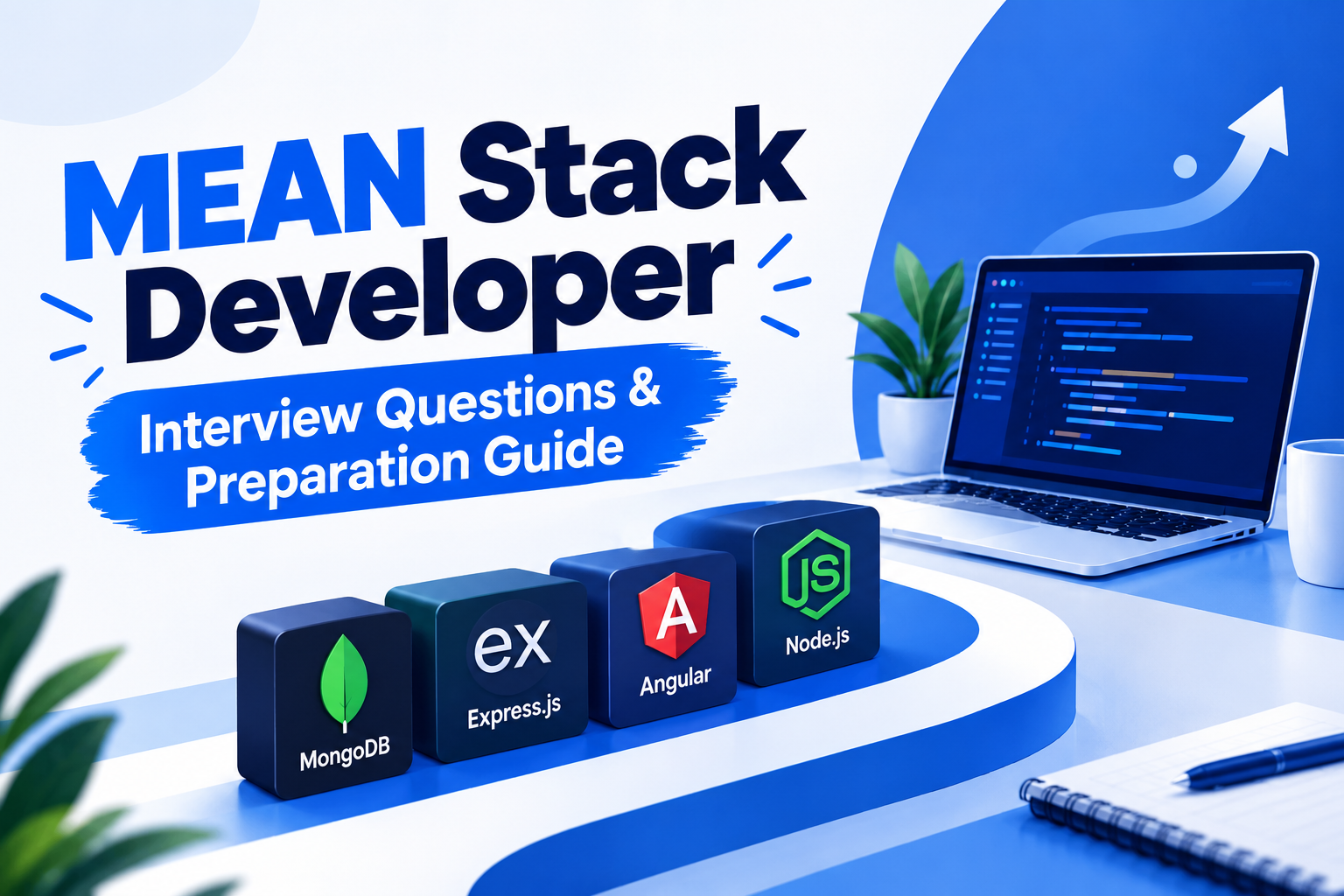
Expect something like the full form of mean stack developer, then what each layer does. MongoDB stores data as documents, Express.js organises server routes, Angular builds the interface and Node.js runs JavaScript on the server. This combination is often called the mean solution stack, and its charm is that JavaScript, with TypeScript on the Angular side, travels through every layer, so JSON can move from database to screen with almost no translation.
They may also ask about REST. A REST style interface treats data as resources with addresses, and uses HTTP methods such as GET to read, POST to create, PUT or PATCH to update and DELETE to remove. A tiny fact that impresses on this call involves MongoDB identifiers. Every document gets an ObjectId by default, and its first four bytes hold a timestamp, so these identifiers roughly sort by creation time. Mentioning that shows curiosity beyond the tutorial path.
Round Two: The Technical Conversation Across Four Layers
This is the round most people picture when they imagine an interview. Two or three engineers ask questions that climb in difficulty, and they listen as much to your reasoning as to your answers.
MongoDB Questions That Reward Honest Trade Offs
Expect the embed or reference question. Embedding keeps related data inside one document for fast reads, while referencing stores an identifier pointing elsewhere to avoid duplication and runaway growth. A single document is capped at sixteen megabytes, so data that can grow without limit, like comments, usually deserves its own collection.
Some panels move on to transactions. Since version 4.0 in 2018, MongoDB has supported multi document transactions, which surprises people who still repeat that it cannot do them. A balanced answer adds that good schema design often removes the need for transactions, because related data that changes together can live in one document, and that transactions carry a performance cost. Mention that WiredTiger has been the default storage engine since version 3.2 if the conversation goes deeper, since it signals you read beyond the surface.
Express and Node.js Questions That Reveal Habits
People new to the topic often ask what express in MEAN stack truly adds. It gives routing, middleware chains and tidy handling of requests and responses, all without forcing a rigid structure on you. Middleware functions run in the order you register them, so sequence matters, which is why authentication checks belong before the routes they protect. Express 5 became the stable release in late 2024 and improved how rejected promises in route handlers are passed to error handling, which is a neat modern detail to drop in naturally.
On the Node side, remember the event loop idea. One main thread handles many connections by handing slow input and output work to the system and resuming when results arrive. Heavy calculation on that thread can block everyone, so panels like hearing about worker threads or moving such tasks elsewhere. Another useful fact is that Node publishes long term support releases, which are the even numbered versions, and production teams generally prefer them for stability.
Angular Questions Written for the Modern Framework
Angular has changed noticeably in recent years, and interviewers notice who has kept up. Standalone components, introduced in version 14 and made the default approach in version 19, reduce the need for modules. A new built in control flow syntax arrived in version 17, replacing older structural directives for conditions and loops. Signals, introduced in version 16, offer a simpler way to track changing values alongside the older observable approach. Angular also follows a predictable schedule of a major release roughly every six months.
You do not need to love every new feature, but showing awareness proves you are not preparing from a five year old tutorial. Pair that with timeless basics like dependency injection, where a class receives what it needs instead of creating it, and observables, which can deliver many values over time and be cancelled, unlike a promise. If you like practising with a wider set of phrasings, an extended collection of practice prompts for this stack is handy for varying the wording until nothing feels rehearsed.
Round Three: The Take Home Task and What Reviewers Notice
Many companies send a small assignment, often a simple application with a list, a form and a few API routes, and ask for it back within a few days. This round can feel unfair, because there is no one to ask questions. Knowing what reviewers actually look at takes much of the fear away.
They notice structure first. Are routes, controllers and data access separated, or is everything inside one giant file? They notice small safety habits next, such as input validation, hashed passwords, environment variables for secrets and sensible error responses. They notice whether the interface handles loading, empty and failed states instead of only the happy path. Finally, they read your README, because a short note explaining how to run the project and what you would improve with more time shows communication skill.
One piece of advice that rarely appears in guides: do less, but finish it properly. A modest mean stack project with clean code, a clear explanation and a working deployment beats an ambitious one that half works. If a requirement is vague, state your assumption in writing and move on, because that is exactly what real teams expect.
Round Four: Design Thinking Questions Without Panic
Senior leaning interviews include a design discussion, where someone asks how you would build or grow a system. Candidates panic because there is no single correct answer, and that is precisely the point. The panel wants to hear your reasoning.
A calm structure helps. Clarify what the system must do and for how many people. Sketch the basic flow from Angular to Express to MongoDB. Then talk about growth honestly. Keep the API stateless so several Node instances can run behind a load balancer. Add indexes where queries are slow, cache frequent reads, and move slow work such as sending email into background queues. On the front end, lazy load features and serve static assets through a content delivery network.
The best candidates also say what they would measure before scaling anything. Guessing at bottlenecks wastes money and time, while measuring finds the real one. If you also mention trade offs, such as the extra complexity that caching adds, you will sound like someone who has been burned once and learned from it.
Round Five: The Human Conversation
The final round is often with a manager or a senior teammate, and it feels different. Technical depth matters less. They are asking whether you would be a good colleague on a hard Tuesday.
Expect questions about a bug that humbled you, a disagreement with a teammate and something you learned quickly. Prepare short, honest stories for each. For the bug, describe what you assumed, how you discovered you were wrong and what you changed in your habits afterward. For the disagreement, show that you listened before defending. For fast learning, pick a real example, such as picking up TypeScript for an Angular project, and describe how you structured your learning.
Also prepare two thoughtful questions to ask them, about how the team reviews code or how new people are supported. Good questions signal that you are choosing a team as much as they are choosing you, which is both true and attractive.
Frequently Asked Questions About the MEAN Stack
These short answers are written to be quick and direct, in case you want a fast refresher before an interview.
What is the MEAN stack in simple words?
It is a set of four technologies for building complete web applications: MongoDB for storing data, Express.js for server routes, Angular for the user interface and Node.js for running JavaScript on the server. One language, JavaScript with TypeScript in Angular, flows through all four layers.
Is the MEAN stack still relevant today?
Yes, especially in organisations that value structure across large teams. Angular remains popular in enterprise projects, and Node.js and MongoDB are widely used on their own. Mean stack jobs and mean stack developer openings continue to appear in product companies, service firms and agencies, and companies using MEAN stack tend to value maintainable code.
How is MEAN different from MERN and MEVN?
Only the front end layer changes. MEAN uses Angular, MERN uses React and the MEVN stack uses Vue.js. Angular is a full framework with built in routing, forms and dependency injection, while React and Vue give you more freedom to assemble your own toolkit.
Do I need a certification to get hired?
Not necessarily. A mean stack certification can help a resume get noticed, but hiring teams usually weigh a deployed project and a clear explanation more heavily. The same applies to any mean stack course or mean stack online course you take along the way. Judge them by how much real building they involve.
Which should I learn first, Angular or Node.js?
Learn JavaScript and TypeScript first, then Node.js and Express, then MongoDB, and finally Angular. Starting with the back end makes the data flow easier to understand when you finally connect the interface.
A Practice Plan That Fits Around a Busy Life
Most people preparing for interviews also have jobs, classes or families, so a plan that demands four hours every evening usually collapses by day three. A smaller plan survives.
Spend about forty five minutes on weekdays and a longer block on one weekend day. In the first two weeks, strengthen fundamentals in JavaScript and TypeScript, then build a tiny Express API. In the third week, add MongoDB through Mongoose and practise embedding versus referencing on paper. In the fourth week, connect a simple Angular interface and deploy the whole thing somewhere public, because a live address changes how you talk about your work.
Every day, add a two minute ritual. Pick one concept and explain it aloud, ideally to another person. Record yourself once a week and listen for vague phrases. Keep a running list of questions you could not answer and answer one each morning. Those small repeated actions build the fluency that interviews quietly test.
Conclusion
Interviews stop feeling mysterious once you see them as five separate conversations instead of one giant exam. The phone screen checks foundations, the technical round explores depth, the take home task reveals habits, the design discussion tests reasoning and the final chat tests character. Prepare for each on its own terms, keep your facts current, and let your own small projects supply the stories.
Some learners find that working through the full stack with a mentor in live online sessions makes the early weeks less lonely, though plenty of people also succeed through patient self study. Whichever route suits you, stay curious, keep practising aloud and trust that steady effort compounds faster than it feels like it should.
About the author
- JustAcademy is an industry focused IT training institute helping students, freshers, and working professionals build practical, job ready technology skills. On this blog, we share practical insights, tutorials, coding guides, career advice, and learning resources covering topics such as Full Stack Development, Java, Python, Data Analytics, Software Testing, QA Automation, Cloud Computing, UI/UX Design, and more. Our goal is to make technology easier to learn through practical knowledge, real world examples, and career focused content. Learn. Build. Upskill. Get Job Ready.
Comments
Join the discussionNo comments yet. Be the first to comment.